
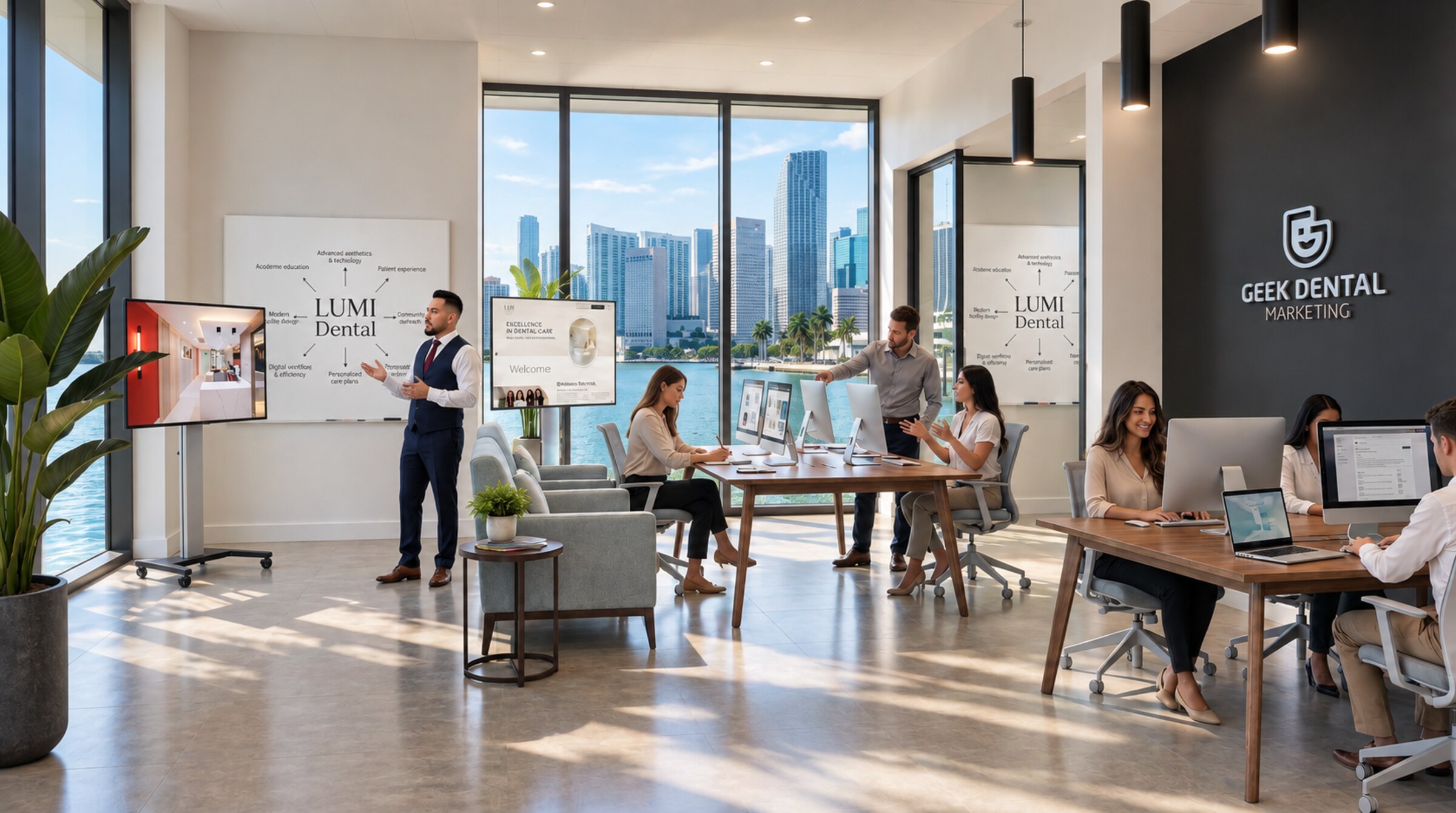
Dental SEO in Miami-Dade County
Short answer
Dental SEO across Miami-Dade County means thinking beyond a single city, since the county spans dozens of distinct municipalities from Aventura to Homestead, each with its own search behavior. A single 'Miami dentist' page cannot carry the weight of that many markets.
Table of contents
- Miami-Dade County is not one search market
- Service-area thinking: who you actually serve versus where you sit
- Which Miami-Dade city pages actually deserve to be built first
- Google Business Profile strategy across a sprawling county
- Tracking progress across multiple Miami-Dade city pages
- Working with a Miami agency on countywide dental SEO
- FAQs
Miami-Dade County is not one search market
Miami-Dade County contains 34 incorporated municipalities plus large unincorporated areas, stretching from Aventura and Sunny Isles Beach in the north down to Homestead and Florida City in the south, with Hialeah, Kendall, Coral Gables, Doral and dozens of other distinct communities in between. A dental practice that builds a single 'dentist in Miami' page and assumes it covers the whole county is missing how granular local search actually is. Someone in Kendall searching 'dentist near me' is shown a different set of map results than someone in Aventura, and Google treats these as separate local markets even though both technically live in Miami-Dade.
This matters most for practices that genuinely serve patients from several parts of the county, whether through one physical location with a wide draw area or several locations spread across different cities. The question is not whether to think countywide, but how to structure content so each municipality a practice actually serves gets a page built for how people in that specific area search, without diluting the site with thin pages for places the practice never realistically reaches.
Service-area thinking: who you actually serve versus where you sit
A single-location practice near the Palmetto Expressway in Westchester might realistically draw patients from Westchester itself, parts of Coral Gables, Fontainebleau and West Miami. That is a real service area, distinct from a practice in North Miami Beach that draws from Aventura, Sunny Isles and Golden Glades. Dental SEO across the county starts by mapping actual patient origin, not aspiration. Pulling the zip codes of the last 12 months of new patients from practice management software gives a factual service area rather than a guess.
- Build full location pages only for cities where real patient volume already exists or where a new office is specifically targeting growth.
- For adjacent areas with lighter but real demand, a shorter service-area section referencing the neighborhood by name can be enough, without a standalone page competing for the same keywords.
- Avoid fabricating pages for distant municipalities a practice does not actually serve just because they are technically in the county; thin, irrelevant pages can drag down the rest of the site in Google's eyes.
Which Miami-Dade city pages actually deserve to be built first
Prioritization should follow patient data and competitive gaps, not alphabetical order. A practical sequence starts with the city the physical office sits in, since that page carries the most direct NAP consistency and map-pack relevance. Next come the two or three adjacent cities that already supply meaningful patient volume. After that, look at search volume and competition together: a city like Kendall or Hialeah has high search volume but also entrenched competitors, while a smaller market like Palmetto Bay may have less volume but far less competition, making it a faster page to rank.
| Priority tier | Example areas | Reasoning |
|---|---|---|
| Tier 1: home base | City the practice physically operates in | Strongest NAP and map-pack signal, built first |
| Tier 2: proven demand | Cities already supplying real patients | Data-backed, lower risk, fastest to convert |
| Tier 3: strategic growth | Underserved nearby cities with light competition | Faster to rank, worth testing before saturated markets |
| Skip for now | Distant municipalities with no real draw | Thin content risk outweighs speculative benefit |
Building pages in this order lets a practice measure traction at each tier before investing further, rather than publishing 15 thin city pages at once and hoping volume follows.
Google Business Profile strategy across a sprawling county
For practices with a single location, the Google Business Profile should stay tied to the actual address and should not claim service areas so broad that they stretch credibility, such as a Kendall practice listing Aventura as a service area 25 miles north. Google increasingly scrutinizes service-area claims that do not match realistic drive times, and overreaching can suppress visibility even in the areas genuinely served. Multi-location groups should instead maintain a separate, fully verified profile for each office, each with its own locally relevant posts, photos and review generation.
Tracking progress across multiple Miami-Dade city pages
Once a practice has built pages for its home base, its proven-demand cities and a strategic growth city, the next job is measuring each one separately rather than watching one blended traffic number. A 90-day checkpoint works well: pull Google Business Profile insights and organic ranking position for each city page individually, since a Kendall page and a Palmetto Bay page can move at very different speeds even when launched the same week. A page in a less competitive market like Palmetto Bay may climb into the map pack within a few weeks, while a page targeting Kendall or Hialeah can take considerably longer simply because more established competitors already hold those positions.
- Set up call tracking by location page so phone inquiries can be attributed to the specific Miami-Dade city that generated them.
- Compare each city page ranking movement against its own starting point rather than against a different city results.
- Reassess the skip list every quarter, since a municipality with no current draw can become worth a page once referral patterns or a new office location shift the real service area.
Working with a Miami agency on countywide dental SEO
Geek Dental Marketing, based at 1395 Brickell Ave Suite 800 in Miami, works with practices across Miami-Dade County to map real service areas, prioritize which city pages to build first, and manage Google Business Profiles for both single-location and multi-office groups. The firm can be reached at 855-966-GEEK to discuss a county-wide strategy built on actual patient data rather than guesswork.
Frequently asked questions
Does a Miami-Dade dental practice need a page for every city in the county?
No. Pages should be built for cities where the practice has real patient volume or a specific growth plan, not for every one of the county's 34 municipalities, since thin pages for unrealistic areas can hurt the rest of the site.
How should a practice decide its real service area in Miami-Dade County?
Pull the zip codes of recent new patients from practice management software to see where people are actually coming from, rather than guessing based on geography or ambition.
Which Miami-Dade city page should be built first?
The city the physical office is located in should come first, since it carries the strongest NAP consistency and map-pack relevance, followed by adjacent areas already supplying proven patient volume.
Can a single Google Business Profile cover a very wide Miami-Dade service area?
It should not claim service areas far beyond realistic drive times from the office address, since Google scrutinizes overreaching claims and this can suppress visibility even in areas genuinely served.
How should multi-location dental groups in Miami-Dade handle Google Business Profiles?
Each office should maintain its own separate, fully verified profile with locally relevant posts, photos and reviews rather than one shared profile trying to represent multiple addresses.
Is search behavior different between Miami-Dade cities like Kendall and Aventura?
Yes. Google treats these as distinct local markets with separate map-pack results, so a single generic 'Miami dentist' page does not effectively compete in either market on its own.
Sources & references
Geek Dental Marketing
Dental search strategists who have spent years helping practices grow visibility on Google, Google Maps and AI-powered search.
Questions about your practice? Call 855-966-4335 (GEEK).
Related articles
Dental SEO in Broward County
Dental SEO in Broward County has to account for a workforce that commutes heavily along I-95 and the Florida Turnpike, suburban communities that function differently from Miami-Dade's urban core, and a growing number of multi-location dental groups competing for the same searches across cities like Fort Lauderdale, Pembroke Pines, Coral Springs and Plantation.
9 min readDental SEO in Palm Beach County
Dental SEO in Palm Beach County has to account for one of Florida's most pronounced seasonal population swings, a large retiree base with specific implant and denture demand, and a county that stretches nearly 50 miles north to south, meaning a single 'Palm Beach dentist' page cannot speak to Jupiter and Boca Raton the same way.
9 min readDental SEO in Homestead, FL
Dental SEO in Homestead has to reflect a South Dade community shaped by agriculture, a tight-knit family-oriented population, close ties to neighboring Florida City, and a real sense of distance from Miami's urban core that residents feel every time they drive north for anything not available locally.
8 min read